Fraction Wall
Every row of the wall is the same length, so you can see which fractions are equal. Shade some pieces, then compare two fractions or take the 10-question challenge.
Loading Fraction Wall…
How to use it
The wall has twelve rows. The top row is one whole. Below it are halves, thirds, quarters, fifths and so on, down to twelfths. Every row is exactly the same length, so you can compare rows by looking straight up and down.
- Explore. Drag your finger or mouse along a row, or tap a piece, to shade from the left up to that piece. The shaded fraction appears beside the row, such as 3/4.
- Watch for equal fractions. When another row is shaded to exactly the same length, both rows light up, and a panel lists every equal fraction on the wall. Try shading 1/2 and look for 2/4, 3/6, 4/8, 5/10 and 6/12.
- Shade any piece. Switch the shading style to Any piece to shade pieces one at a time instead of from the left.
- Hide rows you do not need. Use the row buttons to show only some of the rows, or choose a preset such as halves, quarters and eighths.
- Compare. Pick two fractions and the wall shades them in two colours. It tells you which is bigger and by exactly how much.
- Challenge. Answer 10 questions about equal fractions. Some ask you to pick the matching fraction. Others ask you to shade the matching amount on the wall.
You can use the keyboard too. Press Tab to reach the wall, use the arrow keys to move between pieces, and press Enter or Space to shade up to that piece. Delete clears the row.
Why it works
A fraction describes equal parts of a whole, but a picture of a pizza or a chocolate bar changes shape from question to question. A fraction wall keeps the whole the same length in every row, so the parts can be compared fairly. You can see at once that 1/8 is smaller than 1/4, which surprises many people because 8 is bigger than 4. More parts means smaller parts.
Equivalent fractions are much easier to understand when you can see them. 1/2, 2/4 and 4/8 are not three different amounts. They are the same length with different names. Once children have seen that, the rule about multiplying the top and bottom numbers by the same number makes sense: it is like cutting every piece into smaller pieces and then taking more of them.
Many teachers move children from physical models to pictures, and then to numbers and symbols. The wall sits in the middle. It is a picture you can change with your finger, and the number beside each row connects the picture to the symbol.
A note for teachers: the wall does all of its comparing with whole-number arithmetic, never with decimals. It can never call two fractions different because of a rounding error, so 1/3 and 2/6 are exactly equal here, as they should be.
For parents and teachers
Fraction Wall suits Years 3 to 6. Younger students can use the halves, quarters and eighths preset and simply shade and name fractions. Older students can use Compare and Challenge, or write down a prediction before checking it on the wall.
Questions to ask while a child explores:
- Which rows line up with the halves row, and why? (All the even-numbered rows do, because 2, 4, 6, 8, 10 and 12 are all multiples of 2.)
- Which rows line up with the thirds row? (The ones for 3, 6, 9 and 12.)
- The sevenths and elevenths rows never line up with any other row, except at the very start and end. Why? (7 and 11 are prime numbers, and no other row has a number of pieces that is a multiple of 7 or 11.)
- Which is bigger, 3/4 or 5/8? How could you tell without the wall? (3/4 is the same as 6/8, and 6/8 is more than 5/8.)
- Can you find three fractions that are equal to 2/3? (4/6, 6/9 and 8/12.)
A paper version makes a great hands-on follow-up. Our explainer What is a fraction? has a Try this activity that builds a paper fraction wall from strips of paper.
In class, put the wall on the projector, ask students to show a prediction with a thumbs up or down (is 2/3 bigger than 3/5?) and then reveal the answer in Compare mode.
Settings and challenge scores are stored only in this browser, on this device, and are not sent anywhere. The wall works with touch, mouse and keyboard, and every row and piece has a label for screen readers.
Keep learning
 🍕 Maths
What is a fraction?
A fraction tells you how much of something you have. Slice a pizza, snap a block of chocolate, and find out why 1/2, 2/4 and 4/8 are secretly the same amount, and why people have been writing fractions for more than 3,500 years.
🍕 Maths
What is a fraction?
A fraction tells you how much of something you have. Slice a pizza, snap a block of chocolate, and find out why 1/2, 2/4 and 4/8 are secretly the same amount, and why people have been writing fractions for more than 3,500 years.
 🔢 Maths
What are prime numbers?
Primes are the building blocks of every whole number, they never run out, and they guard your secrets online. Grab a pencil and sift them out with a 2,000-year-old trick.
🔢 Maths
What are prime numbers?
Primes are the building blocks of every whole number, they never run out, and they guard your secrets online. Grab a pencil and sift them out with a 2,000-year-old trick.
 🐝 Maths
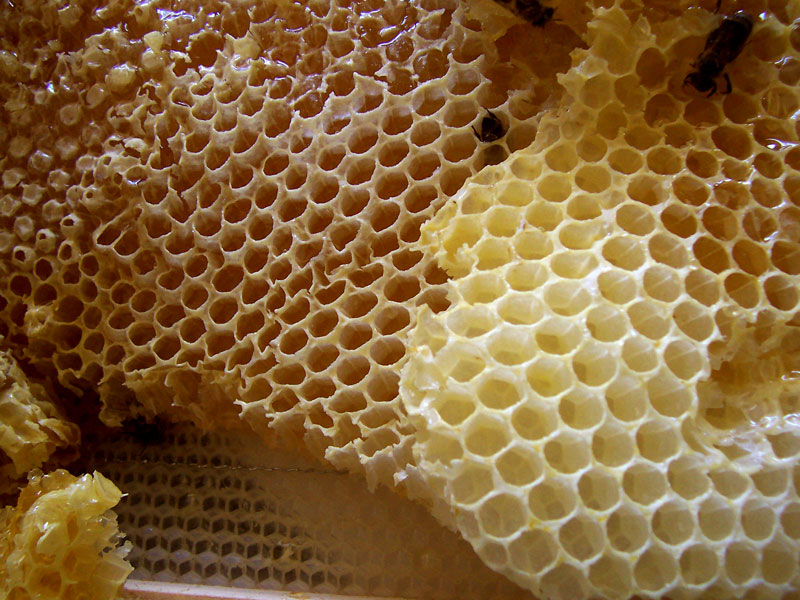
Why do bees build honeycomb out of hexagons?
Six-sided cells fit together with no gaps and use the least wax. People puzzled over it for 2,000 years before a mathematician proved the bees had it right.
🐝 Maths
Why do bees build honeycomb out of hexagons?
Six-sided cells fit together with no gaps and use the least wax. People puzzled over it for 2,000 years before a mathematician proved the bees had it right.