Why do bees build honeycomb out of hexagons?
Six-sided cells fit together with no gaps and use the least wax. People puzzled over it for 2,000 years before a mathematician proved the bees had it right.
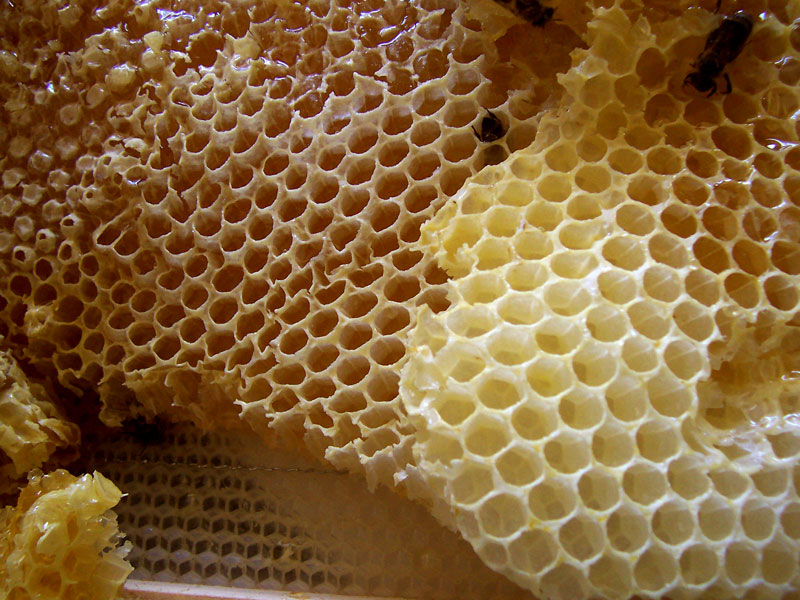
A wall of tiny six-sided rooms
Peek inside a beehive and you will find sheets of wax called honeycomb. Each sheet is made of thousands of tiny cells, and almost every one of them is a hexagon: a shape with six straight sides and six corners. Bees use the cells as cupboards for honey and pollen, and as nurseries where baby bees grow.
The bees make the wax themselves. Young worker bees have special glands on the underside of their abdomen (the back part of their body) that make wax. The bees chew the wax and press it into place to build the walls. When the workers get older and start flying out to collect nectar, their wax glands shut down.
Wax is precious, so a smart building plan should use as little of it as possible while still making lots of storage space. That is exactly what the hexagon does. To see why, we need a little bit of maths.
Why not circles or squares?
Imagine building cells as circles. Push circles together and there are always gaps between them, so space is wasted. Bumblebees really do build round cells, and the gaps between them are wasted space.
To leave no gaps at all, the shapes have to tessellate, which means they fit together edge to edge like floor tiles. Only three regular shapes can do this on a flat surface: equilateral triangles, squares and regular hexagons. People have known this since the time of the ancient Greeks.
Of those three, the hexagon is the closest to a circle. That means it holds the most space for the length of its walls. If a triangle, a square and a hexagon all hold the same amount, the hexagon's perimeter (the distance around the edge) is about 7 per cent shorter than the square's and about 18 per cent shorter than the triangle's. There is another bonus too: a baby bee, called a larva, is roundish, so it fits a hexagon better than a pointy triangle or a square with empty corners.
A 2,000-year-old maths puzzle
People have wondered about honeycomb for a very long time. Around 36 BC, the Roman writer Marcus Terentius Varro wrote about its six-sided cells. Some people back then thought bees chose hexagons because they have six legs! Mathematicians had a better idea: the hexagon holds the most honey for the least wax.
Later, the Greek mathematician Pappus of Alexandria showed that a hexagon beats a triangle and a square. But he only compared those three shapes. What about wobbly shapes, curved shapes, or a mix of different shapes? Nobody could be sure the hexagon was the best of all.
The idea that the hexagon pattern beats every other way of dividing a flat surface into equal-sized cells became known as the honeycomb conjecture. A conjecture is an idea that mathematicians think is true but have not yet proved. Finally, in 1999, the mathematician Thomas Hales proved it. Any way of splitting a flat surface into equal areas needs at least as much total edge as the hexagon pattern. The bees had been right all along.
Clever builders, not perfect ones
Real honeycomb is even cleverer than a flat pattern. Each sheet has cells on both sides, back to back. The bottom of every cell is a pointed shape made from three diamond shapes, and it fits neatly against the cells on the other side, so the bees save wax there too.
Scientists still study how bees build such neat hexagons. One idea was that bees make round tubes and the warm wax slides into hexagons on its own, the way soap bubbles squash into flat walls. But when researchers used heat cameras, they found the wax never gets warm enough for that. The bees seem to shape the walls themselves.
Bees are flexible builders, not machines. When they need to, they can make cells with five or seven sides. The famous scientist Charles Darwin called comb-building "the most wonderful of all known instincts".
Hexagons all around us
Bees are not the only hexagon makers. Paper wasps, which live all over Australia, build nests with six-sided cells made from chewed-up wood. Snowflakes are six-sided too, often with six matching arms, because the water molecules inside ice line up in a hexagon pattern.
Even rocks can crack into hexagons. When a thick flow of lava cools, it shrinks and cracks, often into tall stone columns that are roughly six-sided, though not every one is a perfect hexagon. You can see columns like this at Organ Pipes National Park near Melbourne, where lava cooled about a million years ago.
There is even a giant hexagon in space. At Saturn's north pole, swirling winds form a six-sided pattern about 30,000 kilometres across, more than twice as wide as Earth. Next time you spot a hexagon, ask yourself: what is it saving, and what is it sharing?
📚 Words to know
- Hexagon
- A flat shape with six straight sides and six corners. In a regular hexagon, all the sides are the same length.
- Tessellate
- To fit shapes together like tiles, with no gaps and no overlaps.
- Perimeter
- The total distance around the outside edge of a shape.
- Conjecture
- An idea that mathematicians think is true but have not yet proved.
- Larva
- A baby insect at an early stage of growing up. Bee larvae grow inside the wax cells.
🧪 Try this: pack like a bee
- Put at least ten coins of the same size flat on a table. Push them together as tightly as you can.
- Pick a coin in the middle. How many coins touch it? You should find six. Tightly packed circles make a hexagon pattern, but look at the little gaps between them: that is the space round cells would waste.
- On 1 cm grid paper, draw a square with 6 cm sides. Then draw a hexagon with 4 cm sides: set a compass to 4 cm, draw a circle, then walk the compass around the circle to mark six points and join them with a ruler. Both shapes have a perimeter of 24 cm.
- Count the squares inside each shape (count part-squares as halves). The square holds 36. The hexagon should hold about 41, even though its edge is just as long. That extra space for free is the bees' secret.
🧠 Quick check
4 questionsWhere this comes from
We check our facts against trusted sources. Want to find out more? Try these:
- Thomas C. Hales: The Honeycomb Conjecture — arXiv (1999)
- Gallo & Chittka: Cognitive aspects of comb-building in the honeybee? — Frontiers in Psychology (2018)
- Things about honey bee anatomy you may not know — University of Florida IFAS Extension
- Honey Bee — Australian Museum
- Columnar jointing provides clues to cooling history of lava flows — U.S. Geological Survey
- Saturn: Facts — NASA
- Snowflake science — SnowCrystals.com (Kenneth Libbrecht, Caltech)
- Organ Pipes National Park — Parks Victoria
Keep exploring
 🔢 Maths
How big is a million?
A million seconds is about 11 and a half days. A billion seconds is almost 32 years. Here is how to picture numbers that are too big to imagine.
🔢 Maths
How big is a million?
A million seconds is about 11 and a half days. A billion seconds is almost 32 years. Here is how to picture numbers that are too big to imagine.
 🤖 Computing
What is an algorithm?
An algorithm is a set of step-by-step instructions. A recipe is one, and so is the way you sort a hand of cards. Computers follow them exactly, which is why one tiny mistake matters.
🤖 Computing
What is an algorithm?
An algorithm is a set of step-by-step instructions. A recipe is one, and so is the way you sort a hand of cards. Computers follow them exactly, which is why one tiny mistake matters.
 🪸 Science
How do tiny coral polyps build the Great Barrier Reef?
The biggest coral reef system on Earth was built by soft little animals, many smaller than your fingernail. Here is how they turn seawater into stone.
🪸 Science
How do tiny coral polyps build the Great Barrier Reef?
The biggest coral reef system on Earth was built by soft little animals, many smaller than your fingernail. Here is how they turn seawater into stone.