How do tiny coral polyps build the Great Barrier Reef?
The biggest coral reef system on Earth was built by soft little animals, many smaller than your fingernail. Here is how they turn seawater into stone.

Animals that look like rocks
Snorkel over the Great Barrier Reef and you might think you are floating above a garden of colourful rocks and plants. But corals are actually animals. They are close relatives of jellyfish.
Each coral is made of many tiny animals called polyps. A polyp has a soft body shaped like a little tube, with a mouth at the top surrounded by a ring of tentacles. Fully grown polyps range from a few millimetres to a few centimetres across, and a single coral can be made of hundreds of thousands of them, all joined together. A group like this is called a colony.
There are two main kinds of coral. Soft corals are bendy and often feathery, and each of their polyps has eight tentacles. Hard corals are the builders. Without them, there would be no reef at all.
Turning seawater into stone
A hard coral polyp does something amazing. It takes calcium from the seawater around it and uses it to make limestone, a hard, rocky material that scientists call calcium carbonate. Each polyp sits in a little limestone cup that it builds around the base of its body.
To grow, a polyp buds: it makes a new polyp that is an exact copy of itself. The new polyp builds its own cup right next door. Bud by bud, the colony spreads, and the limestone skeleton underneath gets bigger and bigger.
This is slow work. Big, rounded boulder corals grow about 0.3 to 2 centimetres a year, while branching corals can grow up to about 10 centimetres a year. When corals die, their hard skeletons stay behind, and new corals settle and grow on top. Layer by layer, over thousands of years, all that limestone builds up into a reef.
Solar-powered partners
Living inside the polyps are millions of microscopic algae called zooxanthellae (say zoh-zan-THEL-ee). Like plants, they use sunlight to make sugar. They share that food with the coral, giving it most of the energy it needs. In return, the coral gives the algae a safe home.
The algae also give most corals their colour, usually shades of brown and green. Because the algae need sunlight, reef-building corals grow best in shallow, clear, sunny water.
At night, polyps stretch out their tentacles to catch tiny drifting animals called plankton. The tentacles are armed with stinging cells, just like a jellyfish's.
If the sea gets too warm for too long, corals push their algae out and turn pale or white. This is called coral bleaching. Bleached corals are stressed and hungry, but if the water cools down again, the algae can slowly return and the coral can recover.
A snowstorm under the sea
Budding makes a colony bigger, but how do corals start brand-new colonies somewhere else? Many corals on the Great Barrier Reef do it in one of nature's most spectacular events: mass spawning.
On a few nights after the full moons of October, November and December, whole colonies release tiny bundles of eggs and sperm into the water at the same time. The water fills with clouds of pink, yellow and orange, like an underwater snowstorm. Water temperature and the Moon help the corals time it just right.
A fertilised egg becomes a tiny swimming larva called a planula. It drifts with the currents for days or weeks before settling on a hard surface. There it turns into a single polyp, starts budding, and a new colony begins.
The reef that polyps built
Put countless busy polyps together and you get the Great Barrier Reef, the largest coral reef ecosystem in the world. Its Marine Park stretches about 2,300 kilometres along the coast of Queensland and covers more than 344,000 square kilometres, an area bigger than Victoria and Tasmania combined.
It is not one single reef. It is made up of about 3,000 separate coral reefs, as well as around 600 continental islands and 300 coral cays, which are low, sandy islands that sit on top of reefs. It is home to about 450 types of hard coral and more than 1,600 types of fish.
The oldest part of the reef, in the far north, began to form about half a million years ago, and it has lived through several ice ages since. The reef is also Sea Country for more than 70 Traditional Owner groups, whose connection to it goes back more than 60,000 years.
And every part of it started the same way: with one tiny polyp settling on a hard surface and building a limestone cup.
📚 Words to know
- Polyp
- A tiny, soft-bodied coral animal with a mouth surrounded by tentacles.
- Colony
- A group of living things joined together and living as one. A coral colony can hold hundreds of thousands of polyps.
- Limestone
- A hard, rocky material made of calcium carbonate. Hard corals build their skeletons from it.
- Zooxanthellae
- Microscopic algae that live inside coral polyps and make food from sunlight.
- Spawning
- Releasing eggs and sperm into the water so that young can form.
🧪 Try this: see what coral skeletons are made of
- Ask an adult for a clean piece of eggshell, a clear glass and some white vinegar. Eggshells are made of calcium carbonate, the same material as hard coral skeletons.
- Put the eggshell in the glass and pour in enough vinegar to cover it. Watch closely. Can you see tiny bubbles forming on the shell?
- The bubbles are a gas called carbon dioxide. Vinegar is an acid, and it is slowly breaking down the calcium carbonate.
- Leave the glass somewhere safe overnight, then check the shell. Is it thinner or softer? Seawater is far less acidic than vinegar, but scientists keep a close eye on ocean acidification, a slow change in seawater, because corals need the right conditions to build their skeletons.
- When you are finished, pour the vinegar down the sink and wash your hands.
🧠 Quick check
4 questionsWhere this comes from
We check our facts against trusted sources. Want to find out more? Try these:
- Fascinating facts about the Great Barrier Reef — Great Barrier Reef Marine Park Authority
- Coral and coral cover — Great Barrier Reef Marine Park Authority
- Coral spawning 101 — Great Barrier Reef Marine Park Authority
- Coral bleaching — Great Barrier Reef Marine Park Authority
- Corals — Australian Institute of Marine Science
- Corals tutorial: How do coral reefs form? — NOAA National Ocean Service
Keep exploring
 🌊 Geography
What causes the tides?
Twice a day, the sea creeps up the beach and slides away again. The Moon is pulling the strings, and in north-west Australia the results are enormous.
🌊 Geography
What causes the tides?
Twice a day, the sea creeps up the beach and slides away again. The Moon is pulling the strings, and in north-west Australia the results are enormous.
 🦆 Science
How does a platypus find food with its eyes shut?
When a platypus dives, it closes its eyes, ears and nose. Its soft bill takes over, sensing the tiny electric signals made by the animals it hunts.
🦆 Science
How does a platypus find food with its eyes shut?
When a platypus dives, it closes its eyes, ears and nose. Its soft bill takes over, sensing the tiny electric signals made by the animals it hunts.
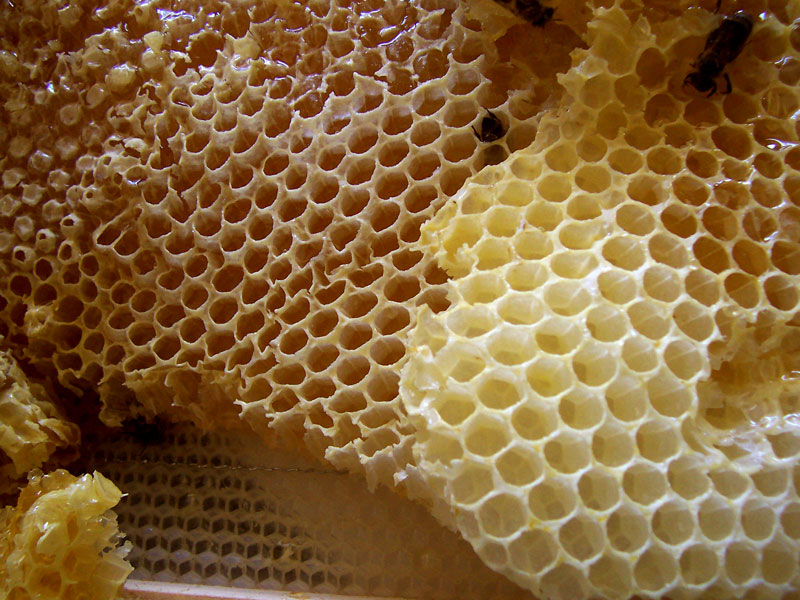 🐝 Maths
Why do bees build honeycomb out of hexagons?
Six-sided cells fit together with no gaps and use the least wax. People puzzled over it for 2,000 years before a mathematician proved the bees had it right.
🐝 Maths
Why do bees build honeycomb out of hexagons?
Six-sided cells fit together with no gaps and use the least wax. People puzzled over it for 2,000 years before a mathematician proved the bees had it right.