What is a fraction?
A fraction tells you how much of something you have. Slice a pizza, snap a block of chocolate, and find out why 1/2, 2/4 and 4/8 are secretly the same amount, and why people have been writing fractions for more than 3,500 years.

A piece of a whole
Imagine you and a friend want to share one pizza. You cut it into two pieces that are exactly the same size, and each of you gets one half. We write that as 1/2. Halves, thirds, quarters and eighths are all fractions. A fraction tells you how much you have when something, called the whole, has been split into equal parts.
The word fraction comes from a Latin word meaning "a breaking", as in breaking something into pieces. The whole can be anything you like. It could be a pizza, a block of chocolate, a metre of ribbon, an hour of time, or a group of things, like a packet of 12 lollies.
One rule matters more than any other: the parts must be equal. If you cut a pizza into two pieces and one is much bigger, neither piece is a half. Look at the pizza in the photo. Its eight slices are nearly the same size, so each one is about one eighth.
Two numbers, two jobs
A fraction is written with two numbers, one above the other, with a line between them. Take 3/8. The bottom number is called the denominator. It tells you how many equal parts the whole has been cut into. The top number is the numerator. It tells you how many of those parts you are talking about. So 3/8 of a pizza means three slices from a pizza that has been cut into eight equal slices.
The two names come from Latin. Numerator comes from a word meaning "counter", because it counts the pieces you have. Denominator comes from a word meaning "to name", because it names the kind of piece you are counting: eighths, thirds, fifths or tenths.
When the top number is 1, as in 1/2, 1/3 or 1/8, the fraction is called a unit fraction. It is just one single piece. Here is something that surprises many people. The bigger the bottom number, the smaller each piece. If a pizza is cut for 2 people, each slice is huge. If it is cut for 8 people, each slice is much smaller. So 1/8 is smaller than 1/4, even though 8 is bigger than 4. The more people sharing, the less each person gets.
Same amount, different names
Cut a pizza into 2 equal halves and take 1. Now picture the same pizza cut into 4 equal quarters, and take 2. You have exactly the same amount of pizza. Cut it into 8 slices and take 4. It is still the same amount. So 1/2 = 2/4 = 4/8. Fractions that stand for the same amount are called equivalent fractions.
A block of chocolate shows it too. Imagine a block with 12 squares in 3 equal rows of 4. Snap off one row. That is 4 squares out of 12, so it is 4/12 of the block. But there are 3 equal rows, so one row is also 1/3 of the block. That means 4/12 = 1/3. Half the block is 6 squares, so 6/12 = 1/2.
There is a handy rule. If you multiply the top and the bottom numbers by the same number, you get an equivalent fraction. 1/2 becomes 4/8 when you multiply both numbers by 4. You have cut every piece into smaller pieces, and you take more of them. It works backwards too. Divide the top and bottom of 4/12 by 4, and you get back to 1/3. Making a fraction simpler like this is called simplifying it.
Fractions of a group, and fractions as sharing
Fractions do not always need a pizza. To find 3/4 of 12 lollies, split the 12 into 4 equal groups. There are 3 lollies in each group. Now take 3 of the groups. That makes 9 lollies, so 3/4 of 12 is 9.
Fractions also give the answer when you share things that do not divide evenly. Suppose 3 chocolate bars are shared fairly between 4 children. Cut each bar into 4 equal pieces, and that makes 12 pieces. Each child gets 3 pieces, each of which is 1/4 of a bar. So each child gets 3/4 of a bar. In other words, 3 ÷ 4 = 3/4. The line in a fraction can be read as "divided by".
Fractions are numbers, too, and they have their own places on a number line. Between 0 and 1, the fraction 1/2 sits exactly halfway. Fractions can also be bigger than 1. A pizza cut into quarters, with 5 quarters on the table, is 5/4 pizzas, which is 1 whole pizza and 1/4 more.
Fractions everywhere, for a very long time
You use fractions every day. A quarter past three is a quarter of an hour after 3 o'clock, which is 15 minutes. A recipe might call for half a cup of flour. In Australia, a 50 cent coin is half of a dollar, and five 20 cent coins make a whole dollar, so each 20 cent coin is 1/5 of a dollar. Even a ruler uses them. A centimetre is one hundredth of a metre, and a millimetre is one thousandth.
People have used fractions for thousands of years. The Rhind Mathematical Papyrus was written by an Egyptian scribe called Ahmose (also spelt Ahmes) more than 3,500 years ago. Its problems include fractions, and the first ones ask how to share loaves of bread between ten men. The ancient Egyptians mostly used unit fractions, such as 1/2, 1/3 and 1/4. They did not write a fraction like 2/5. They wrote it as 1/3 plus 1/15. The Rhind papyrus even has a table of these.
📚 Words to know
- Fraction
- A number that tells you how many equal parts of a whole you have, such as 1/2, 3/8 or 5/6.
- Numerator
- The top number of a fraction. It counts how many parts you have.
- Denominator
- The bottom number of a fraction. It tells you how many equal parts the whole is cut into.
- Unit fraction
- A fraction with 1 on top, such as 1/2, 1/5 or 1/10. It is one single part of the whole.
- Equivalent fractions
- Fractions that name the same amount, such as 1/2, 2/4 and 4/8.
🧪 Try this: build a paper fraction wall
- Ask an adult for paper and a safe pair of scissors. Cut six strips of paper, each exactly 24 centimetres long and about 3 centimetres wide. You will also need a ruler and a pencil.
- Leave the first strip whole and write 1 on it. Mark the second strip into 2 equal parts of 12 centimetres. Mark the third into 3 parts of 8 centimetres, the fourth into 4 parts of 6 centimetres, the fifth into 6 parts of 4 centimetres, and the sixth into 8 parts of 3 centimetres. Write the right fraction on every part, such as 1/2, 1/3, 1/4, 1/6 and 1/8.
- Stack the strips under each other, with their left ends lined up. Look for places where the lines match up. You should find that 1/2 lines up with 2/4, 3/6 and 4/8. These are all equivalent fractions.
- Challenge: use your wall to find out which is bigger, 1/3 or 1/4. Then find which is bigger, 3/4 or 5/8. Can you find another fraction that is equal to 1/3?
🧠 Quick check
4 questionsWhere this comes from
We check our facts against trusted sources. Want to find out more? Try these:
- fraction (word origin) — Dictionary.com
- fraction — American Heritage Dictionary
- numerator — Dictionary.com
- denominator — Dictionary.com
- Fractional Wall — NRICH, University of Cambridge
- Teaching Fractions With Understanding: Part-Whole Concept — NRICH, University of Cambridge
- Egyptian Fractions — NRICH, University of Cambridge
- Content description VCMNA157: Equivalent fractions — Victorian Curriculum and Assessment Authority
- An overview of Egyptian mathematics — MacTutor History of Mathematics, University of St Andrews
- Mathematics in Egyptian Papyri — MacTutor History of Mathematics, University of St Andrews
- Who was the first recorded mathematician in history? — University of Waterloo
- Bloom and Elsholtz: Egyptian Fractions — arXiv (2022)
- Circulating coins — Royal Australian Mint
- Metric (SI) prefixes — NIST
- SI prefixes — Bureau International des Poids et Mesures
Keep exploring
 🔢 Maths
How big is a million?
A million seconds is about 11 and a half days. A billion seconds is almost 32 years. Here is how to picture numbers that are too big to imagine.
🔢 Maths
How big is a million?
A million seconds is about 11 and a half days. A billion seconds is almost 32 years. Here is how to picture numbers that are too big to imagine.
 🐝 Maths
Why do bees build honeycomb out of hexagons?
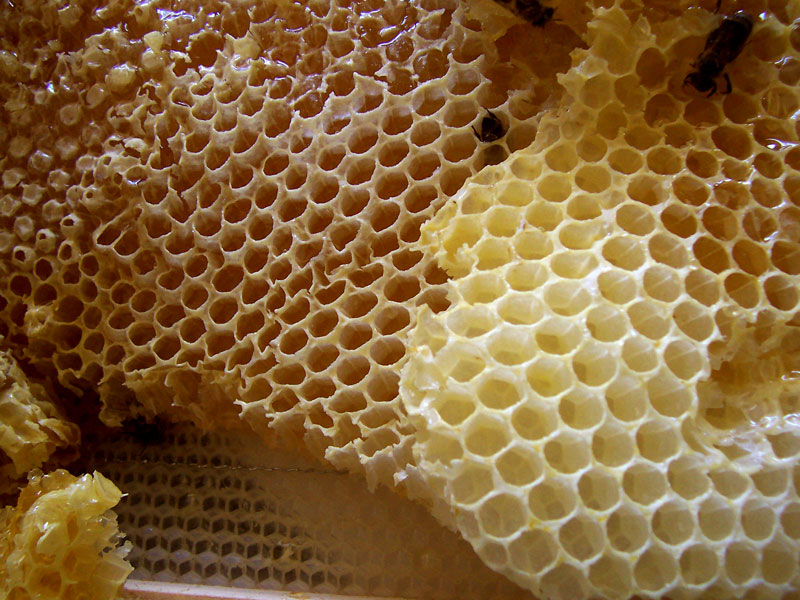
Six-sided cells fit together with no gaps and use the least wax. People puzzled over it for 2,000 years before a mathematician proved the bees had it right.
🐝 Maths
Why do bees build honeycomb out of hexagons?
Six-sided cells fit together with no gaps and use the least wax. People puzzled over it for 2,000 years before a mathematician proved the bees had it right.