How do bees make honey?
No bee makes honey alone. Follow a drop of nectar from a flower to a wax cell, meet the bees that fan it dry, then find out how Australia's tiny stingless bees make a tangy honey called sugarbag.

It starts with a flower's sweet drink
Honey begins as nectar, a sugary liquid that flowers make to attract insects. Nectar is mostly water, about 70 to 80 per cent, mixed with sugars. A honey bee drinks it through a long, hollow tongue called a proboscis, which works like a drinking straw.
The bee does not swallow the nectar to digest it. Instead, it stores the nectar in a special pouch called the honey stomach, which is kept just for carrying. A bee can fly up to about 5 kilometres from its hive to find flowers.
As a bee feeds, pollen sticks to its fuzzy body and rubs off on the next flower it visits. This is called pollination, and it helps plants make seeds and fruit. Honey bees pollinate many crops and wildflowers while they work.
A relay through the hive
Back at the hive, the bee that collected the nectar, called a forager, does not store it herself. She passes it, mouth to mouth, to a younger worker bee called a house bee. All the worker bees in a hive are female. Younger workers usually stay inside the hive, and older ones fly out as foragers.
Every time the nectar is passed along, the bees add an enzyme called invertase. An enzyme is a chemical that speeds up a change. Invertase breaks the sugar in nectar, called sucrose, into two simpler sugars, glucose and fructose.
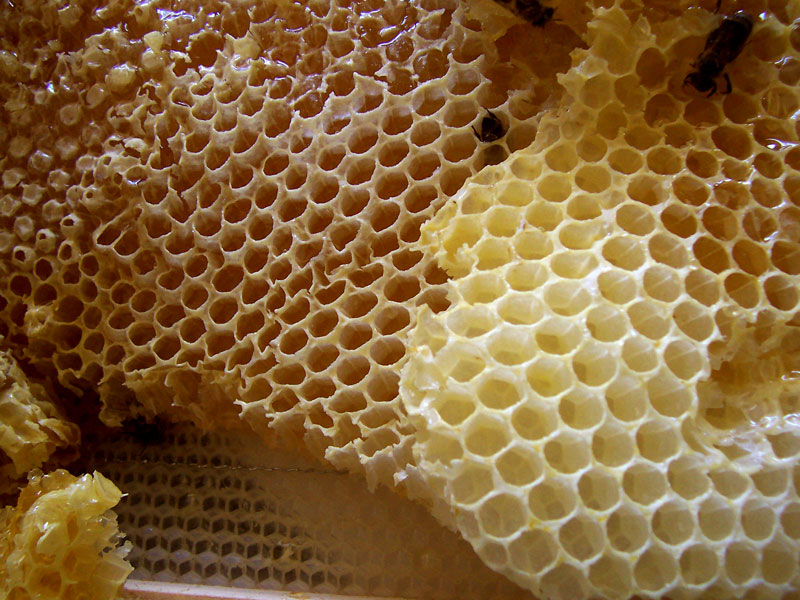
Then a house bee spills the nectar into a wax cell in the honeycomb. It takes many loads of nectar to fill just one cell. But the nectar is not honey yet. It is still far too watery.
Fanning the water away
Nectar is about 70 per cent water, but ripe honey has less than about 20 per cent (Australian food law allows no more than 21 per cent). So the bees have to dry the nectar out. To do it, they fan their wings over the open cells. This keeps air moving across the comb and helps the water evaporate.
When the nectar has turned into honey, the bees seal the cell with a lid of fresh wax. The lid is airtight. If it were not, the honey would soak up water from the air and could start to spoil.
Finished honey has so little water in it that germs such as bacteria and fungi cannot grow in it. This is why honey keeps so well. The flavour depends on the flowers the nectar came from. Different flowers make different honeys, in different colours and tastes.
Why go to all this trouble?
Honey is the colony's food store. Honey bees do not hibernate in winter. They stay in the hive, huddled together to keep warm, and eat the honey they saved when flowers were out. It takes a lot of bee work to fill the store. One estimate says that a worker makes only about one-twelfth of a teaspoon of honey in her whole life.
Honey bees are not native to Australia. The first hives arrived in March 1822, and more were brought later. Today beekeepers move hives to farms, where their bees help to pollinate crops such as almonds, apples, avocados, pumpkins and blueberries. The Australian Honey Bee Industry Council says Australian honey has flavours that are unique to our native plants.
Sugarbag: honey from a native bee
Honey bees are not the only bees that make honey in Australia. There are also eleven kinds of native stingless bees, in two groups called Tetragonula and Austroplebeia. These bees are small and black, only about 4 or 5 millimetres long, roughly a third the length of a honey bee. They cannot sting, and they live in warm parts of the country, from Queensland and northern New South Wales to the north of Western Australia and the Northern Territory. A nest can hold thousands of bees, and it is usually built inside a hollow tree.
A stingless bee nest is built a little differently from a honey bee hive. The bees mix wax with sticky resin that they collect from trees. In one common kind, the nursery cells where baby bees grow are built in a neat spiral. The honey is not kept in six-sided cells. It is stored in clusters of little round pots near the edge of the nest. Full pots look like a glowing bunch of grapes.
Their honey is called sugarbag. It is runnier than honey bee honey because it has more water in it, and it tastes tangy, with flavours such as lemon or eucalyptus that come partly from the resin. Aboriginal people have gathered sugarbag from wild nests for thousands of years. It is rare, because a hive makes only about 1 kilogram a year. Taking honey from nests in cooler places can weaken or even kill them, so if you find a wild nest, leave it alone.
📚 Words to know
- Nectar
- The sweet liquid that flowers make. It is mostly water, with some sugars, and it is what bees turn into honey.
- Proboscis
- The long, hollow tongue that a bee uses like a drinking straw to suck up nectar.
- Enzyme
- A chemical made by a living thing that speeds up a change. Bees add one that splits nectar's sugar into simpler sugars.
- Pollination
- Carrying pollen from one flower to another so that plants can make seeds and fruit.
- Sugarbag
- The tangy honey made by Australian native stingless bees. It is stored in small pots made of wax and resin.
🧪 Try this: race honey against "nectar"
- Ask an adult to help. You need two plates, runny honey, water, a spoon, a timer and a book. Honey is not safe for babies under 12 months, so keep it away from little brothers and sisters.
- Stir 1 teaspoon of honey into 2 teaspoons of water on the first plate. This is a little like nectar, thin and watery. Put 1 teaspoon of plain honey on the second plate.
- Prop both plates up on the book so they slope at the same angle. Tip each spoonful to the top edge of its plate at the same moment, and time how long each takes to run down.
- The "nectar" should race down while the honey creeps. That is why bees have to fan the water away: thick honey is packed with sugar and has too little water for germs to grow in. What would the honey have been like if the bees had stored the thin nectar instead?
- Challenge: mix 2 teaspoons of honey with 1 teaspoon of water and race that too. Is it faster than honey, slower than "nectar", or in between?
🧠 Quick check
4 questionsWhere this comes from
We check our facts against trusted sources. Want to find out more? Try these:
- How Do Bees Make Honey? (It's Not Just Bee Barf) — NC State University
- How do bees make honey? — BBC Science Focus
- How do bees make honey? From the hive to the pot — Live Science
- Honey Bee — Australian Museum
- Stingless Bee — Australian Museum
- Honey Production with Stingless Native Bees — Aussie Bee
- Australian Native Stingless Bees — Aussie Bee
- Secrets of Stingless Bee Breeding — Aussie Bee
- Fernandes et al.: Strong antimicrobial activity and unique characteristics in honey from Australian stingless bees — Applied and Environmental Microbiology (2025)
- A bicentennial of honey bees — Australian Honey Bee Industry Council
- The Nobel Prize in Physiology or Medicine 1973: press release — Nobel Prize
- Infant botulism — NSW Health
- Standard 2.8.2 - Honey — Australia New Zealand Food Standards Code
- An exploration of the relationship between recruitment communication and foraging in stingless bees — PubMed Central
Keep exploring
 🐝 Maths
Why do bees build honeycomb out of hexagons?
Six-sided cells fit together with no gaps and use the least wax. People puzzled over it for 2,000 years before a mathematician proved the bees had it right.
🐝 Maths
Why do bees build honeycomb out of hexagons?
Six-sided cells fit together with no gaps and use the least wax. People puzzled over it for 2,000 years before a mathematician proved the bees had it right.
 🌱 Science
How do plants make their own food?
Plants never eat, yet they can grow taller than a house. Their secret is photosynthesis: using sunlight to turn air and water into sugar, with oxygen as the leftover.
🌱 Science
How do plants make their own food?
Plants never eat, yet they can grow taller than a house. Their secret is photosynthesis: using sunlight to turn air and water into sugar, with oxygen as the leftover.