What happens to the things we recycle?
Your recycling does not just disappear. Follow a bin from the kerb to a giant sorting plant, see where each material ends up, and find out the honest story about soft plastics and why a few wrong items cause so much trouble.
Into the yellow bin
Most Australian homes have a recycling bin, and in many places it has a yellow lid. In some areas paper or glass gets its own bin, with a blue or purple lid. Every week or two, a truck empties the bin, and the load heads to a sorting plant.
What goes in? Usually glass bottles and jars, steel and aluminium cans, paper and cardboard, and hard plastic containers such as milk bottles, shampoo bottles, takeaway containers and yoghurt tubs. The rules are not exactly the same everywhere, so it pays to check your own council's list. You can also search by postcode on Recycling Near You, a website run by the charity Planet Ark, or look for the Australasian Recycling Label on packaging.
Recycling goes in loose, never in a plastic bag. Bagged recycling is usually sent to landfill, and opening bags can hurt the people who sort it. In many states and territories, you can also take some drink bottles and cans to a collection point and get 10 cents back for each one, under a Container Deposit Scheme.
A trip through the sorting plant
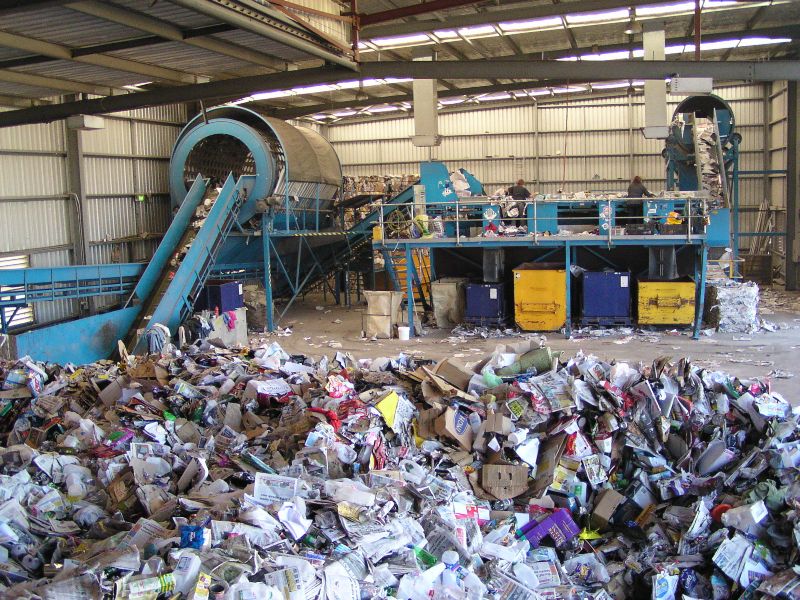
The truck delivers your recycling to a materials recovery facility, or MRF. Its job is to turn one big mixed pile into separate piles of paper, cardboard, glass, plastic, steel and aluminium. In 2017, the sorting plant at Hume in Canberra received more than 200 tonnes of recycling every day. Some plants rely mostly on people, and others have a lot of machines.
First, workers on the tipping floor pull out anything that clearly does not belong. Then the pile rides up a conveyor belt to a trommel, a giant rotating drum with holes in it that works like a sieve. It sorts things by size and shape. Flat paper and cardboard are carried on, while bottles and cans fall through. A shaking machine called a ballistic separator, and more screens, shake broken glass out of the paper.
Next come the magnets. A powerful magnet lifts out steel cans. Aluminium is not magnetic, so a machine called an eddy current separator flings aluminium cans off the belt into their own bin. For plastics, optical sorters use cameras and light to identify each container, and jets of air blow it into the right bin. People check the last few items by hand. Then each material is squashed into a block called a bale and sent off to be made into something new.
Where it all goes next
Bales of paper and cardboard go to a paper mill. There they are mixed with water into pulp, then cleaned of ink and made into new sheets of paper. Much of the cardboard we use is made from recycled paper. Aluminium cans are crushed and melted in a furnace and made into new products. Recycled aluminium needs about 95 per cent less energy than making new metal from ore, and it can be recycled again and again without losing quality.
Glass is crushed into pieces called cullet. Clean glass can be melted to make new bottles and jars. Glass that is not good enough for bottles can be crushed into a sand-like grit and used instead of natural sand in road base, footpaths and concrete. Plastic is harder. There are many kinds, and they have to be separated before they can be melted down. Drink and milk bottles are the easiest, because there are buyers for them. In 2024–25 only about 13 per cent of Australia's plastic waste was recycled, and about 86 per cent went to landfill.
Geography matters here too. For years Australia shipped much of its paper and plastic to China, more than 600,000 tonnes a year. On 1 January 2018 China stopped accepting 24 kinds of waste. Recycling piled up in warehouses and some councils struggled to find buyers. Australia now has laws that control what waste can be sent overseas. Waste glass has been regulated since 1 January 2021, plastic since 1 July 2021 and mixed paper and cardboard since 1 July 2024, and only properly processed waste can leave the country.
Why a few wrong items cause big trouble
Sorting plants are built for certain things only. Items that cannot be recycled, or that spoil other recycling, are called contamination. In 2020–21, around 14 per cent of what Australians put in their recycling bins was contamination. Common culprits are soft plastics, food, clothing and bagged recycling. One household's wrong item can contaminate a whole truckload, because everything gets mixed together in the truck.
Each wrong item causes its own kind of trouble. Soft plastics wrap around machinery and cause blockages and shutdowns. Batteries can start fires in trucks and plants. Broken glass is a danger to workers, and the tiny pieces spoil paper and are hard to sort by colour. Takeaway coffee cups, polystyrene foam, drinking glasses, ceramics, nappies and old clothes also belong in the red-lid rubbish bin or in a special drop-off.
Here is a common myth. A number inside the triangle on a plastic container tells you what type of plastic it is. It does not tell you that the container can go in the yellow bin. To be sure, check your council's list or the Australasian Recycling Label instead.
The soft plastics story
Soft plastics are plastics you can scrunch in your hand, such as bread bags, chip packets and cling wrap. In most places they do not belong in the yellow bin, because they tangle in the machines. For about a decade, though, a program called REDcycle let shoppers drop them in bins at the front of supermarkets. At its peak it collected from around 2,000 stores.
In November 2022 REDcycle paused its collections. Its recycling partners had stopped taking the plastic, and millions of bags turned out to be stored in warehouses instead of being recycled. Many people felt let down. Since then, supermarkets have started to rebuild the system. In May 2026 Woolworths reopened soft-plastic collection in more than 700 of its stores. Woolworths, Coles and Aldi have also joined together in a group called Soft Plastics Stewardship Australia, which is building a new national scheme. It is still being rolled out. It is not in every state and territory yet, and not everyone lives near a store that takes soft plastics.
So what should you do? Check whether a supermarket near you has a soft plastics drop-off, or whether your council runs its own collection. If you cannot reach a scheme, put soft plastics in the red-lid rubbish bin, not the yellow one. Better still, use less in the first place. Recycling comes after reducing and reusing.
📚 Words to know
- Materials recovery facility
- A sorting plant where mixed household recycling is separated into paper, glass, plastic, steel and aluminium. People call it an MRF.
- Contamination
- Items in the recycling bin that cannot be recycled or that spoil other recycling, such as food, soft plastics and bagged recycling.
- Cullet
- Crushed, recycled glass. Clean cullet can be melted to make new bottles and jars.
- Soft plastics
- Plastic packaging you can scrunch in your hand, such as bread bags, chip packets and cling wrap.
- Bale
- A big block of one material, such as paper or cans, squashed and tied up so that it can be moved and sold.
🧪 Try this: be a mini sorting plant
- Ask an adult to help. Collect a handful of clean, dry items from your recycling: a steel food tin (check that its edges are smooth), an aluminium drink can, a plastic bottle, a sheet of paper and a stiff piece of cardboard, bigger than your hand. Do not use anything sharp, wet or dirty, and wash your hands afterwards.
- Do the magnet test. Hold a fridge magnet against each item. Which ones stick? A real sorting plant uses a huge magnet to lift out steel cans. Most food tins are steel and most drink cans are aluminium, but check each one yourself.
- Do the size test. Ask an adult to cut a round hole about 12 centimetres across in the lid of a cardboard box, and rest the lid over a tub. Tip on the can, the tin, the bottle, the paper and the cardboard, then shake the lid gently. Which items fall through and which stay behind? The small round containers should drop through, and the big flat paper and cardboard should ride on. This is a little like the trommel drum, which sorts by size and shape.
- Make a tally chart with three columns: yellow bin, red bin and not sure. For one week, look at the packaging of everything you finish before it goes in a bin. Check your council's website or Recycling Near You for anything in the 'not sure' column.
- Challenge: at the end of the week, which material was most common? How many soft plastics did you find? Pick one item you could use less of next week.
🧠 Quick check
4 questionsWhere this comes from
We check our facts against trusted sources. Want to find out more? Try these:
- How much waste do Aussies generate and where does it all go? — Planet Ark, Recycling Near You
- Recycling Aluminium Cans — Planet Ark, Recycling Near You
- Recycling Cardboard — Planet Ark, Recycling Near You
- National Waste and Resource Recovery Report 2026 (2024-25 data) — Department of Climate Change, Energy, the Environment and Water
- National waste and resource recovery report 2024 (2022-23 data) — Department of Climate Change, Energy, the Environment and Water
- Australian plastics flows and fates report 2024-25 — Department of Climate Change, Energy, the Environment and Water
- Waste exports — Department of Climate Change, Energy, the Environment and Water
- From kerbside yellow bins to the recycling plant: What happens to your rubbish? — ABC News
- 'The demise of kerbside recycling'?: China ban disrupts rubbish removal and fills warehouses — ABC News
- How recycling is actually sorted, and why Australia is quite bad at it — SBS News
- Recycling education and resources (virtual material recovery facility) — Visy
- Recycling (yellow-lid bin) — Inner West Council
- Plastic recycling information — The Hills Shire Council
- Recycling in Brisbane — Brisbane City Council
- Recyclable: yes or no? — Australian Museum
- Recycling kerbside glass in local roads — City of Canada Bay
- What's happening with soft plastic recycling? — CHOICE
- Plastic bag recycling program collapses — The Canberra Times (AAP)
- Woolworths reinstates soft plastics collection — Inside Retail Australia
- Everything you need to know about Australia's new soft plastics recycling scheme — Time Out Australia
Keep exploring
 🌧️ Geography
Where does rain come from?
Every drop of rain has been on a long journey: up from the sea as invisible vapour, into a cloud, and back down again. Follow the water cycle, Australian style.
🌧️ Geography
Where does rain come from?
Every drop of rain has been on a long journey: up from the sea as invisible vapour, into a cloud, and back down again. Follow the water cycle, Australian style.
 🌊 Geography
Why is the sea salty?
Rain, rivers and hot vents on the seafloor have been delivering salt to the sea for ages. Follow a grain of salt from a rock to your tongue, then visit a lake in the outback where the salt has nowhere to go.
🌊 Geography
Why is the sea salty?
Rain, rivers and hot vents on the seafloor have been delivering salt to the sea for ages. Follow a grain of salt from a rock to your tongue, then visit a lake in the outback where the salt has nowhere to go.